By Pastor Paul Deming, Ben Gunter, and Dell J. Rose
One of the requirements for those who are pursuing ordination with the Swedenborgian Church of North America is something that is referred to as “camp experience.” Candidates must attend either Almont Summer School in Michigan, Fryeburg New Church Assembly in Maine, or an approved equivalent. The purpose of this requirement is to experience intergenerational ministry, practice informal pastoring, design and deliver at least one lecture on the camp’s theme, and observe and participate in a denominational cultural experience.
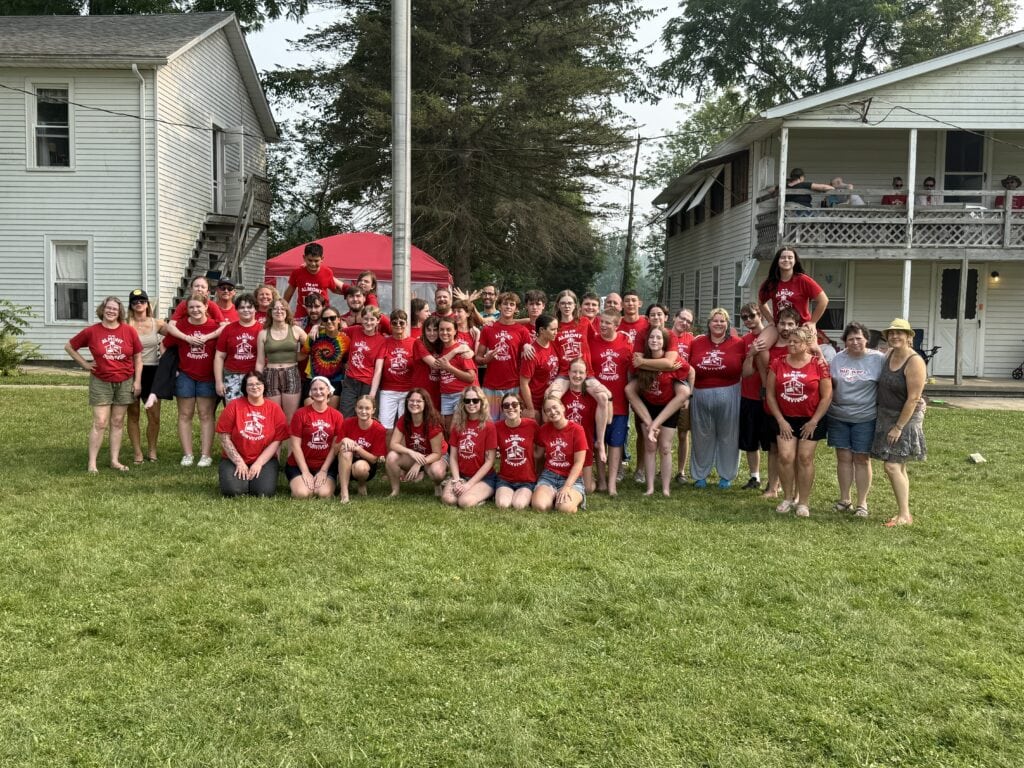
This summer Pastor Paul Deming, Ben Gunter, and Dell Rose (who are all on the path to ordination) attended Almont Summer School (almontnewchurchassembly.org) and have shared their experiences here.
A Week to Remember!
By Pastor Paul Deming
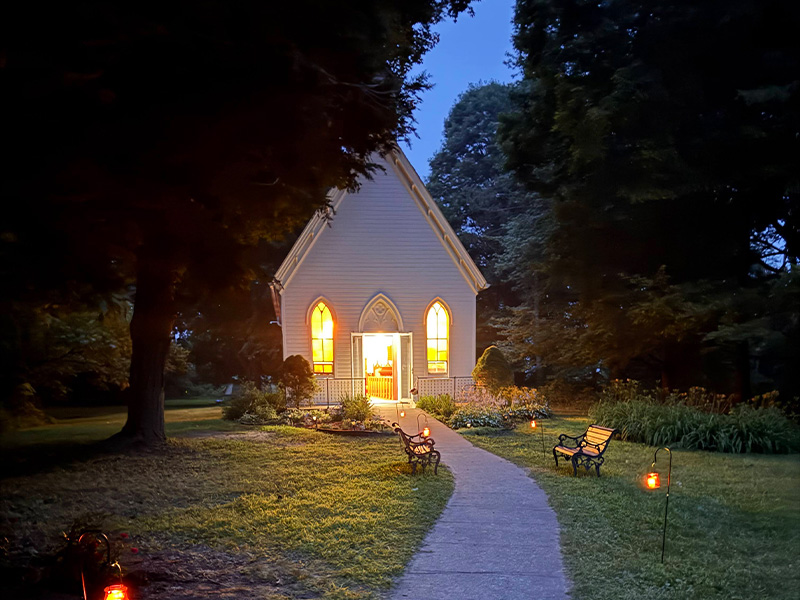
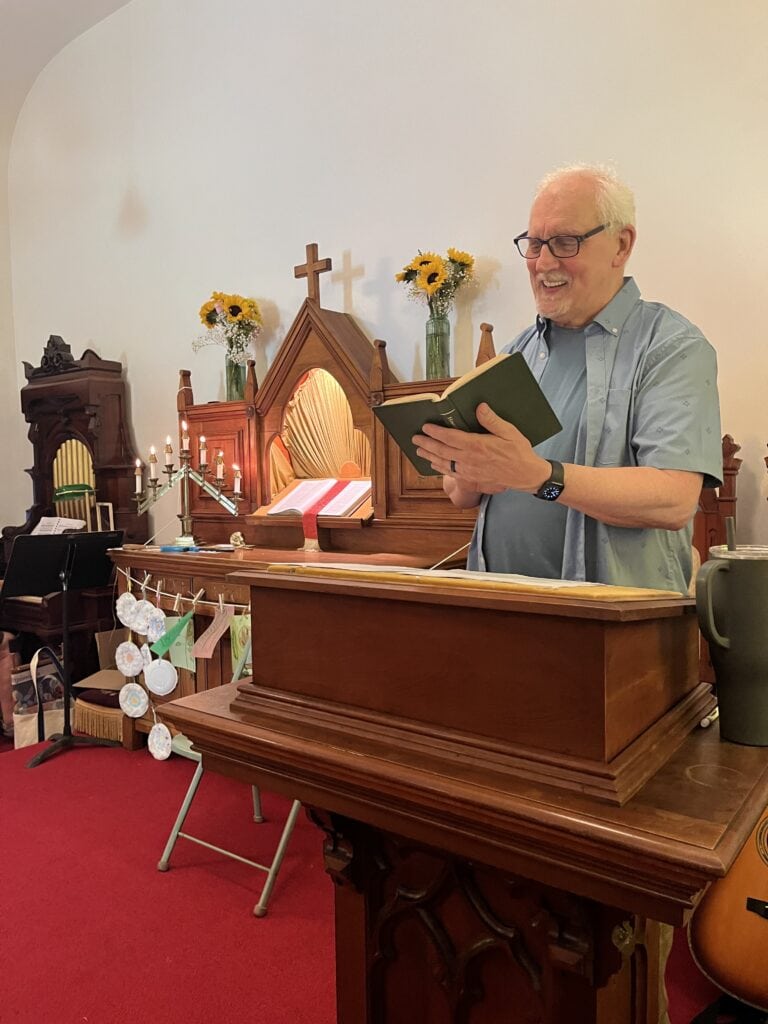
One might think that summer camps are all fun and games (and some lectures) but this one… well, it was even more special! The theme for the week was the Seven Days of Creation. Rev. Jane Siebert started us off with a Sunday morning communion service in the historic Almont chapel. This was day one of creation–and if it was any sign–the rest of creation would have its own challenges. It turns out the communion grape juice became tainted when it was poured into the flagon (which must have had rust or something inside) and what everyone sampled with their communion drink was as close to bitter as you could imagine. What would normally be a poignant sacrament turned into a Stephen King movie, with people making the most disgusted expressions and children acting like they were retching on the church carpet. What made it especially humorous was Rev. Renée Machiniak exclaiming at the beginning of the ceremony, after the bread was consumed, “Oh this is much better than last year,” only to retract that statement after the bitter juice, “This is definitely not better than last year!” Rev. Jane took it all in stride, knowing this would be a memorable experience!
This was my introduction to summer camp. Days two through seven proved equally interesting, with record heat in the high nineties, which is unusual for Michigan. Remember: camps don’t come with air-conditioning. When you get assigned a room, you open a window and pray for a breeze!
My roommate for the first few days was a lovely gentleman, Elliot, who came to offer lectures about the Quran and how it explains the days of creation. He was also a guitar player, so I found much common ground and enjoyed our discussions.
I especially loved the morning-sing with the raising of the flag, as well as the evening-sing with the lowering of the flag just before chapel service. The regulars sang it with reverence as newcomers (like me) struggled to remember all the words.
Although cell phone reception was sketchy at best, my wife called to warn me of the dangerous invisible parasite that was traced to vegetables in Michigan (among other places). She begged me not to eat any lettuce for fear of experiencing “explosive diarrhea.” “It’s OK honey,” I told her, “They’ve already tried to poison me with communion, and I’m still here, although it’s dang hot!”
On Wednesday, I drove into town to do my laundry and when exiting the laundromat, I noticed a strange fog had descended upon the town, but as soon as I smelled what could only be burned wood, I realized that the smoke from the Canadian fires had descended upon the camp. For the next few days, it was advisable to wear masks, especially for those with asthmatic conditions. This was already a summer camp to remember!
The camp was not without additional special moments. At one meal in the dining hall, fellow ordinand Ben Gunter was sitting across from me having just arrived the night before. At the end of the meal, it was announced that each camper would be allowed only one cookie. Ben blurted out, “What is this, the Soviet Union?!” “I heard that, Ben!” yelled Laurie, the facility manager and food service director, who was all the way across the room. She appeared with lightning speed at the table and explained to Ben the necessity of making sure each person was offered at least one cookie before taking seconds. I especially enjoyed the “busted” expression on Ben’s face at her reaction.
While the camp offered opportunities to meet new friends and hear interesting lectures, the pinnacle of enjoyment, for me, was performing in the Almont Orchestra under the skillful baton of Becky Shelly Moore. There is something about music that unites for performer and listener alike. This was the prelude to the talent show where campers got to hear a variety of skits, songs, poems, and performances. I was touched by the community feel and encouragement each performer was given with applause and cheers. Even though it was my first year at summer camp, this felt like family.
I learned new board games, engaged in lecture discussions, and played on “Karenaoke Night” with the most talented keyboardist (Karen from the Royal Oak church society) as teens and adult campers had a chance to sing almost any song they wished. A highlight was when all the teens sang “Don’t Stop Believing!” Rev. Renée and Joe Machiniak did a wonderful duet and Renée’s niece Bella proved, once again, that a gift of a golden voice can stop people in their tracks to listen.
On the morning of day seven, Rev. Sage Cole was leading a discussion on the spiritual significance of a day of rest. I was so captivated as I was taking my morning meds that I didn’t realize that I might have swallowed a hearing aid battery that had been mixed in with the pills. Talking to the camp doctor, it was agreed I would get an x-ray at a nearby Urgent Care and get checked out. I drove about five miles away and spent three hours at the Urgent Care verifying that I indeed had absentmindedly swallowed the small pill-sized battery (a lesson in mindfulness for me!). The ingestion hotline suggested I just let it pass naturally and get another x-ray back in St. Louis (which ultimately happened and everything is fine). However, while I was at the Urgent Care, a thunderstorm had blown through the area creating havoc with the roads (fallen limbs and branches) and, driving back to camp, I was shocked to see how much damage the storm had done in less than three hours. Returning, I discovered that the camp was now without power. It would be several hours before power was restored. Like every other challenge the week had presented, campers embraced the situation with the most positive spirit and resilience.
The lectures on each day of creation provided much food for thought and discussion throughout the week as different ordinands and ministers offered their own style of presentations and creative insights.
The Almont summer camp experience provided me a chance to meet many of the spirited young people that make our denomination what it is, and I appreciated the chance to hear many stories from those who have lived the Almont experience from childhood through adulthood. Many relaxing discussions were enjoyed on the porch of the Big House with a phrase that keeps playing in my head, “We hope to see you again next year!”
High Church of Almont
By Ben Gunter
When we describe the practice of churches, we use a certain vernacular about ritual and community. A Protestant parish might be “high church” if it has a neo-gothic building and incense and vestments. Or it might be “low church” if it meets in a strip mall with a pastor who wears a t-shirt.
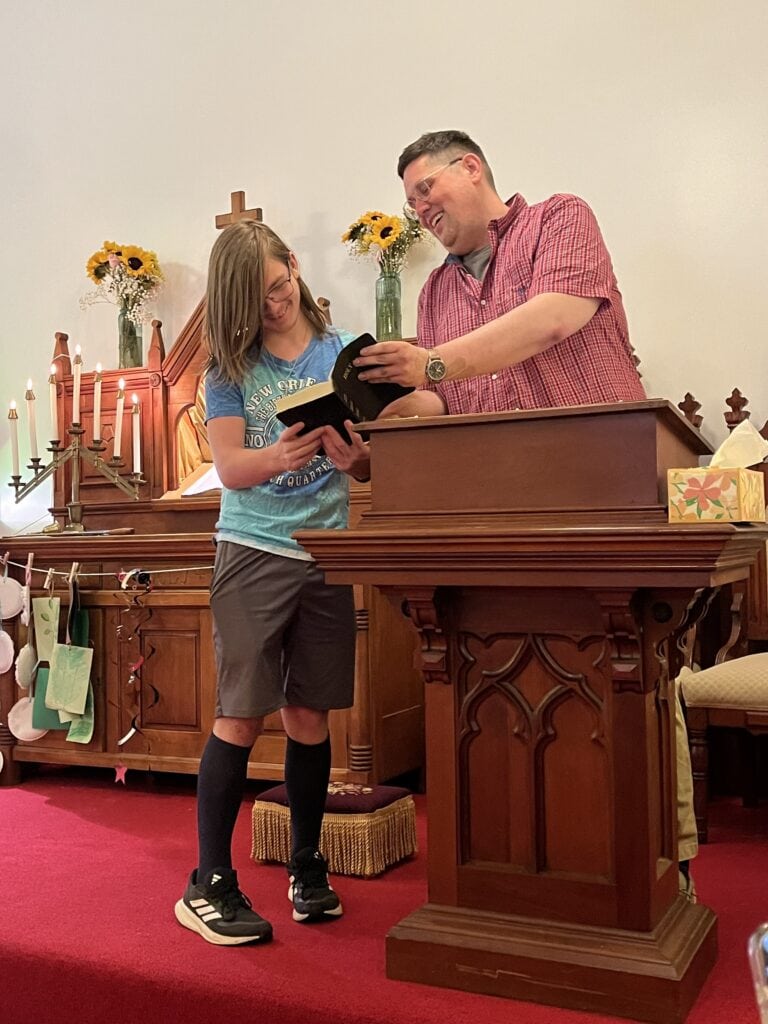
I will confess to quite a bit of cognitive dissonance with this language. On the one hand, it seems outright condescending to refer to a simpler, sparser (maybe lower-budget) practice as “low.” Who are we to judge how people choose to worship God?
On the other hand, I am a total sucker for high church. Whether it’s my attention dysregulation or my childhood experiences with religion, I find that a little bit of ritual and sensory stimulation go a long way in making the Divine accessible to me.
So why would someone with a propensity to lean on high church to feel connected to God, like me, feel that way swimming through the hellish humidity of Michigan, collecting mosquito bites, choking on wildfire smoke, and eating cafeteria food?
In pondering this, and in hearing people talk about it, I settled for a while on the idea that the difficult and rustic conditions make campers bond over shared challenges. After seeing the Survivor ritual, I realized that that’s not it at all.
What I realized is that Almont is the “high church” of Swedenborgian summer camp.
The parents and grandparents, alumni of the Survivor ritual, who put on suits and gowns to take a nighttime walk to the lake, are dressing for their high church. The teens who sincerely look forward to partaking in Holy Communion as the highlight of their year are preparing for their high church. The children forming an orderly single-file line and patiently waiting to negotiate how many Jolly Ranchers a quarter can buy at the Candy Lady table are processing into their high church sanctuary.
When the Holy City comes down to Almont, adorned as a bride for her husband, its clothes might not be what we expect. It might look like mud and sweat and the tears of joy cried by generations of campers, all passing down timeless rituals and gathering ‘round the flagpole.
That is the real high church.
Thank you to everyone who has kept this tradition alive and for welcoming me into the community.
Without Adornment
By Dell J. Rose
Anthropologist Victor Turner (1920–1983) was interested in that palatable acceptance that came when social hierarchies were disbanded. He named it communitas, defined as “an unstructured or minimally structured group of individuals in a state of equality, solidarity, and togetherness.” The experience of other people confronting “life with its teeth out,” to quote the writer Janet Frame (1924–2004). Almont was such a place for me.
For many in the denomination, Almont was the first encounter with the warmth of the Swedenborgian tradition, shorn of the baggage of ‘church’. It is a place where people learn of the kingdom of uses without adornment. With mud on the trousers and through the red-eyed tiredness of myriad late-night conversations about the entirety of the human condition. At Almont, Swedenborg’s teachings about the necessity of angelic community seem both clear and a certainty.
To release the proverbial cat, I was terrified by the thought of camp. I never attended sleep-away camp as a youth, and I had no idea that I would be attending it on the cusp of middle age, but, as an ordinand, I had to go, and I did. And I am very grateful for it. But, were I to say that I was looking forward to the experience, that would be a lie.
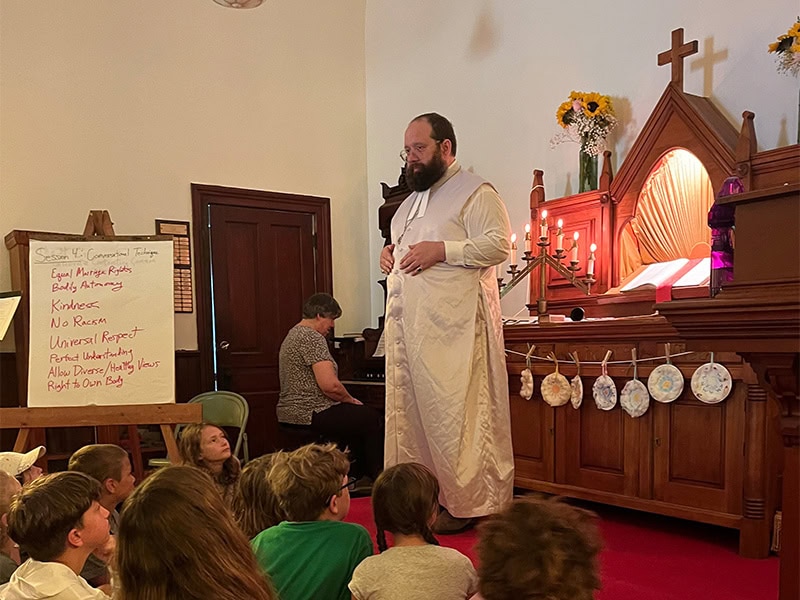
Quizzically, many of the worries I had about the natural realities of the camp did turn out to be just as I feared: no air-conditioning, Pepsi products, or Wi-Fi. But I rarely thought about them. I worried for days about whether or not I would get my emails in time and then never thought to check them anyway. As an introvert with a glorious sense of humor—and I know everyone else would agree (or I pretend they would)—I was concerned about the constant proximity of other minds. But what started as a feeling of social claustrophobia ended with the realization about what Almont truly is: not a camp, but a place where people have the courage to be completely who they are.
Like heaven, you are stripped away at Almont. The lodging is what it is. The food is what it is. And you, for better or worse, are just you. The personas we wear with such skill in the wider world are just a hindrance there. At first it is only a disorientation; you feel as though the ground underneath you is shifting. But, if you give in to it, before long the magic of the place appears to you, and you find that pure release that is so rare it meets you like an ache. Whatever it is, it is alright at Almont. To be sweaty, fat, thin, ugly, pretty, uncoordinated, or cynical, there’s room at the table for you. When you leave, there’s a longing to be there again. Not for the water pressure, not for the ninety-degree heat, but to be who you were there. Just sun cream and mosquito spray required. See you next year (three days maximum).
Read the full September 2026 issue.