By Dr. Rebecca Esterson
This past summer, the Department of Defense (DOD), under the direction of Defense Secretary Pete Hegseth, dropped 180 faith groups from its official list of religious codes for service members. The list, which was reduced from 211 religions to just 31, is used for collecting information on the religious affiliation of service members to assist military chaplains in planning and providing religious support. The new list excludes minority religious groups, and critics have charged that the move is part of efforts by the Trump administration to limit religious diversity in support of Christian Nationalism.
From a Swedenborgian perspective, the history of this DOD list is a fascinating one. Like other religious minorities, we were dropped in this latest 2026 revision. In the first year of the Trump administration, however, we were added to the list, or at least we were included in a new way. In 2017, the Department expanded its list of “Faith and Belief Codes for Reporting Personnel Data of Service Members” from just over 100 to 211, including the addition of “General Conference of the Swedenborgian Church,” which was tracked with the code B7. We were not totally absent up to this point, however, and prior to the 2017 expansion, the list included “Churches of the New Jerusalem” identified by the code XJ. Both categories, General Conference of the Swedenborgian Church and Churches of the New Jerusalem, appeared from 2017–2026, and both are now absent from the new list of codes. This does not mean that service members cannot self-identify as Swedenborgian, or that Swedenborgians can’t be military chaplains, only that there isn’t a recognized code for service members who identify this way for the purpose of gathering data and planning chaplaincy services. At least this is my best understanding of the situation.
The recent move to restrict codes for military faith groups to only the world’s major religious traditions has received a fair amount of backlash, most publicly from the Church of Jesus Christ of Latter-day Saints, who objected to being listed outside the subcategory of Christian religions (the military has removed the category altogether in response, and now lists different Christian traditions alongside non-Christian ones without subcategories). Swedenborgians have much to object to with this recent development, both in solidarity with other religious minorities who have been erased, but also because of our presence and contribution to American military history.
This history often begins during the Revolutionary War with reference to Reverend Jacob Duché, an Anglican minister who was invited by Samuel Adams to open the first Continental Congress in prayer on September 7, 1774, in the presence of George Washington. Duché’s role as religious advisor to George Washington and the Congress would be a troubled one, as his later stance against the war resulted in his exile to London, where he would eventually become one of the earliest followers of Emanuel Swedenborg, before returning to live the remainder of his days as a Swedenborgian in Pennsylvania.
Among our tradition’s greatest military chaplains is Rev. Arthur O. Brickman, founding minister of First German New Jerusalem church in Baltimore, where he served from 1854–1861. Brickman had been Lutheran prior to 1853, when he encountered the teachings of the New Church. The following year he was tried for heresy and excommunicated by the Lutheran synod, on charges of having embraced the doctrines of Swedenborg.
In Baltimore, Brickman was involved in pro-Union activities and eventually left his congregation to serve as a chaplain in the Union army under Ulysses S. Grant. He was elected chaplain to the First Maryland Regiment of Cavalry but served without formal appointment until he petitioned Abraham Lincoln directly in an 1861 letter.
The Messenger published several letters sent by Brickman from the front lines in 1864 and 1865, while he was stationed with the infantry in Virginia near Petersburg and Danville. His letters describe his position, not removed from the front lines, but in trenches and under fire alongside the service members he ministered to. He writes “under a shower of balls from the rebel sharpshooters in front” and reports that the “loss in dead and wounded in my regiment is fearful; we have been literally cut to pieces.”
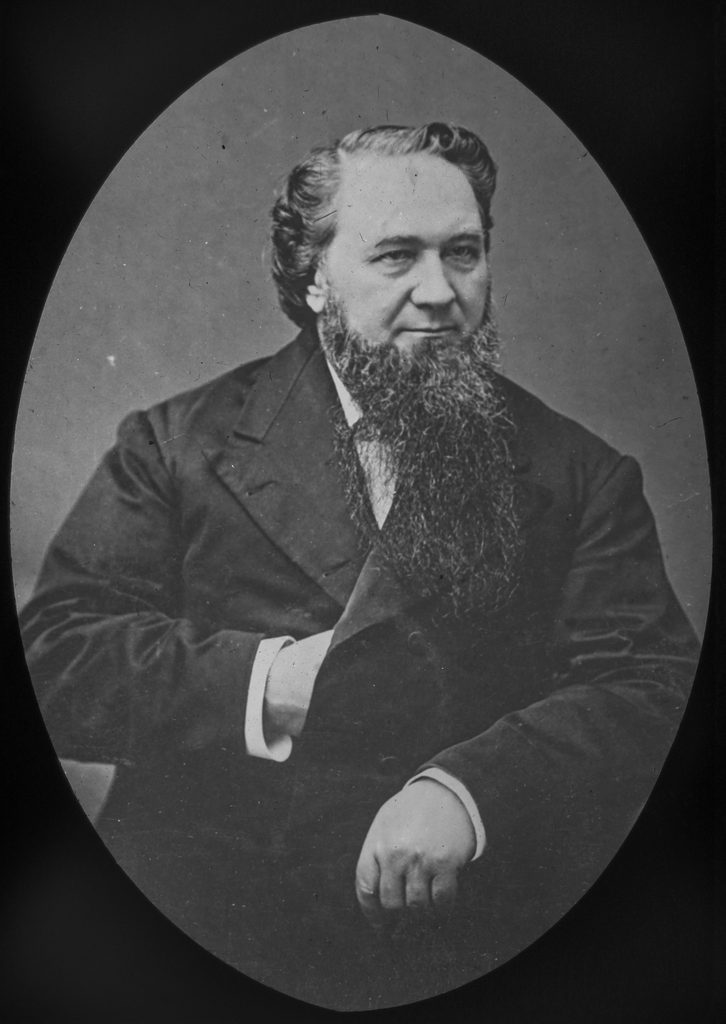
Brickman’s letters lament his disconnection from Swedenborgian life. He has not been able to attend Convention or to receive and read the Messenger, “I long very much after spiritual food and bodily rest. I hoped to visit the Convention this year, and see once more my old friends, but this pleasure I had to forego on account of my position in the army.” He nevertheless is strengthened in spirit when meeting other New Church service members from Massachusetts and Baltimore “who are full receivers of the heavenly doctrines.” He receives a volume of Heaven and Hell in the mail, which brings him comfort, but asks for copies of New Church tracts that he can pass out, noting the wide circulation of other religious tracts “Jewish, Roman Catholic, Unitarian, or Universalist papers.”
Brickman’s letters describe his activities as a military chaplain. He writes of visiting the sick and preaching, all while under fire, and complains about chaplains who avoid the more dangerous locations for their ministry. He keeps worship every night in a chapel tent, even though the structure is heavily damaged by Minié balls and the sound of fire is constant.
In one of his last letters, he summarizes his teachings as inclusive of “the doctrine of the Lord, the internal sense of the Scriptures, and the doctrine of life. My demonstration of the soul and the future world seems especially to please all who hear me.”
I teach the New Church truths fearlessly, openly, and boldly, but never attack any sectarian doctrines. My preaching is positive; I show what is true, and use the common sciences, and above all the letter of the Word, to demonstrate and illustrate the truths of the New Christian Church. My audience is usually large, and will interspersed with officers of high and subordinate ranks. The interest in my sermons and lectures, all of which I deliver without any manuscript before me, has constantly increased, and not a day is passing by but somebody calls upon me, asking for information about the New Church and her doctrines.
As Brickman’s reputation as a chaplain grew, he was elected to the position of president of the Association of Chaplains of the Ninth Army Corps, which communicated with the Secretary of War on chaplaincy matters. He would later be awarded a gold medal for his service, and was a beloved and popular preacher and lecturer, in English and in German, in the years after the war.
A fuller history of Swedenborgian military chaplains is yet to be written. Such a history would feature more recent representatives, such as Rev. Andy Stinson, who served in the Iraq War. Swedenborgian military chaplaincy is an important part of U. S. history. In our better moments, our nation is one that celebrates religious diversity and the contribution of minority religious traditions. We have been a nation of many religions, large and small, since the beginning. Swedenborgians have always been in the mix, and will continue to be, whether or not we make the list.
Read the full October 2026 issue.
Meet Rebecca Esterson
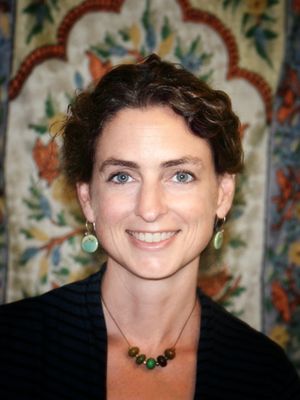
Dr. Rebecca K. Esterson is the dean of CSS and the Dorothea Harvey Professor of Swedenborgian Studies. She teaches in the Department of Sacred Texts and Their Interpretation at the GTU in Berkeley, California and is a member of the Swedenborg Society of the East Bay.