By Betty Yenetchi
My name is Betty Barnes-Yenetchi, and I would like to share my story of loss and awareness with you. I will keep it as pleasant as possible. However, all of you who have had the pleasure of talking to me know that I tend to be somewhat verbose. In this story, I will make it more concise.
After the death of my husband, Carl, on March 2, 2023, I was plunged into deep grief, a grief so intense that I was not sure I would ever be free of it. Just a few short months later, I had a stroke. This stroke was like a thief that came in the night and stole my sight, insight, and personality. The significant loss of my sight was the most severe to me because it took my independence. I had to relearn how to be in the new world. I was in despair and determined to heal.
When I had my stroke, I knew that if my husband Carl were living at the time, he would have moved heaven and earth to see that I received everything I needed to heal. But he was gone, and I felt alone. After a stroke, people can feel alone. I did. I felt angry at my body. I even felt envious of people who did not have to worry about their bodies. I lived with the fear of it happening again.
Months passed, and I was still grieving. I had lost Carl, and the stroke had stolen so much from me that I wasn’t sure how to move ahead. My daughter suggested we talk with a neurologist to see if there was something else we could do. We made an appointment and went to see the doctor. She listened to us and asked if we had ever heard of neuroplasticity. We said no, and she began to tell us about rewiring the brain, or neuroplasticity.
When we came away from her office, we felt pleased that finally we had a clear path to follow. Wanting to know more about neuroplasticity, I searched online and found a class that taught me how to rewire my brain. The class began the next day. The first thing I learned was that rewiring is another name for neuroplasticity, which is the brain’s ability to make new connections and pathways. I was eager to try this.
After the class, I began to work with the elements as given in the class. The thing I knew I had to do was choose a complex topic to study that would stimulate my brain. As my husband had been a Swedenborgian minister, I decided to make Swedenborg the topic of my study.
I began to study alone and quickly realized that I was going to need help with this line of study. Several people recommended Rev. McCluskey as someone who was somewhat of an authority on Swedenborg. I asked him, not knowing if he would be willing because he really did not know me very well.
We worked mostly by email after we discussed my low vision problem, and he agreed to always use large print when communicating with me. Our studies focused on the key concepts of Swedenborg, such as good and truth, useful service, and the proprium, to name a few.
I had two favorites: good and truth and the proprium.
I began to learn things that I had not known before, and that gave me hope. Specifically, I learned about good and truth and about being of useful service. Swedenborg’s idea of useful service is open-ended, and that mattered to me. I realized that useful service is “People helping people.”
Also, I would be remiss if I did not mention that Rev. McCluskey encouraged my journaling, which led to a rebirth of my poetry. For this alone, I truly owe him a big thank you for this precious gift.
Poetry was a part of my life before the stroke. As a matter of fact, I was a child when I became interested in poetry. My older brother was my listener. He would listen to me recite one of my poems, and he would critique gently so as not to hurt my feelings. He was my favorite brother, and he passed two months before his eightieth birthday and two months before my husband passed. For my birthday, he would often buy me a book of poetry. Every time I think of my brother, I think about my poetry. He died of a stroke. Sam, I love you, and I miss you.
Before the stroke, I had not been writing poetry for some time because I was too sad to spend my time writing poetry. After all, I needed time to cry. Then, when I began journaling, which my study buddy had suggested, my writing automatically turned to poetry. I told my study buddy that, and he smiled.
Before the stroke, I enjoyed words and thoughts, and I could use words to influence or bring enjoyment to someone. However, after the stroke, I had changed so much. I had to learn new ways of thinking, remembering, and understanding the world around me. Even the person I had always thought of as myself seemed to be harder to find or to connect with.
Then my brother and my husband brought me back into poetry. They were on my mind so often that it led me back to poetry. I really did not know where this was going to lead me, but just writing helped to steady my mind. I followed my urge to write and did so.
It was more than a bunch of words on a page; it was communication with my soul. After the stroke, poetry began helping me write myself back into my own life. Words began to lead me to reaching the parts of myself that felt lost. Little by little, poetry became a way to gather the scattered pieces of my experience. This way, I could give shape to feelings that I could otherwise not explain. Also, I could listen to the voice that was still inside me.
Before the stroke, I wrote poetry because I enjoyed it. After the stroke, I needed poetry for something deeper in me that could help me find meaning in what had happened to me. I needed to recognize what I remembered and what was something else. Either way, a deeper understanding of what I now was was essential to my well-being.
Before the stroke, I never worried about my thoughts, but now, who I was, where I was going, and why I was doing all these varied things were questions that tickled my soul and spirit. When I sit down to write poetry, a light shines within me, and I am no longer afraid of what I am going to find out. Connecting with deeper truth is something I want to know and do. It is the good and truth of Swedenborg.
Before Rev. McCluskey turned to his other work, he introduced me to two people who gave me work that kept me on target with neuroplasticity. I continue to work with them today.
One of those people was Rev. Rich Tafel, who conducted a prayer service every Sunday. Thank you for all the support you gave and still give me today. It was fun listening to sermons and learning more about the close attention to the Word, gifts from Divine Providence. Thank you for all the conversations when I was sick.
Dell Rose, who is the program director of the Swedenborgian Library in Chicago, also offered his kindness and support. As a matter of fact, Dell Rose learned that I liked to laugh, and he made me laugh quite often.
My studies were going well, and I had hope that new pathways were growing. I started studying the philosophers. It felt nourishing to be learning again. I joined some study groups and was rewarded with deeper learning. After a stroke, learning can feel like stretching.
I went to see my neurologist. She told me that everything had healed except a spot in my neck where the stroke had begun. She said they hoped that it would continue to heal, and she thought the neuroplasticity would aid the healing of that spot.
Then an eye therapist started working with me. She asked me what I wanted to do to grow new pathways in my brain. I told her I wanted to learn the Lord’s Prayer in Aramaic. She agreed that it was a good idea. We began with one word at a time. She also gave me eye exercises that would stimulate my brain.
One day, I realized I felt like myself again. My therapist said that she had noticed that and was happy that I had grown so much. And yet I knew something was not quite right, but I trusted in the Lord and knew all would be shown to me.
Thank you to Kimberly Catlett, Karen Feil, Karen Conger, Dawn Fox, Tammara Mounce, Jackie Shihadeh, and all of my study buddies, Rev. Sue Turley, and Rev. Eric Allison.
As Swedenborgians, you stepped up, and you stepped out. You did not pout, and you did not doubt, because you knew what it was all about. Thank you. And the Lord said, “ Whom shall I call?” And you each replied, “Here am I, Lord, send me.”
Read the full November 2026 issue.
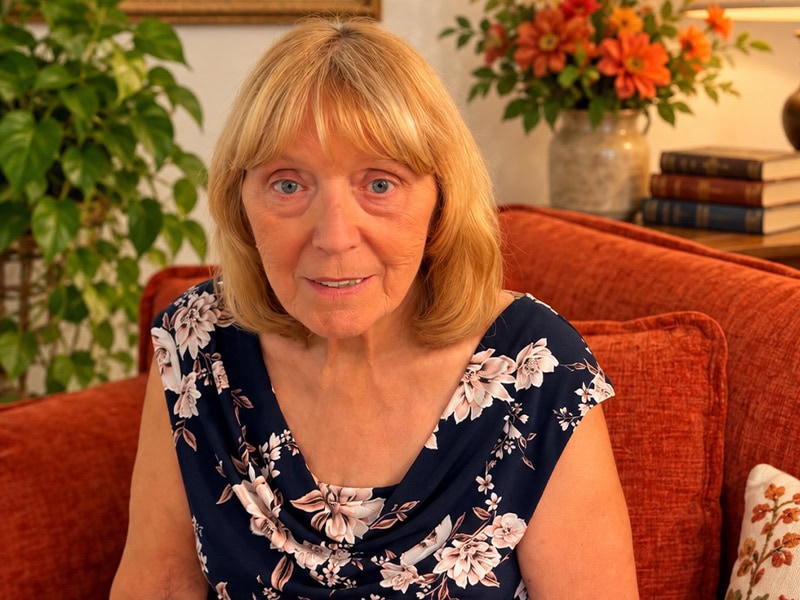
Meet Betty Yenetchi
Betty Barnes-Yenetchi lives in Florida and has been a Swedenborgian since 1980. Her family is of the utmost importance to her, and her spiritual life is her ruling love. In 2023, Betty experienced a stroke that greatly influenced her writing and deepened her love of poetry. Her belief in “people helping people” and the Swedenborgian principle of useful service have contributed to her spiritual growth. Betty graduated Summa cum laude with a Bachelor of Science in public relations. During her studies, she incorporated Swedenborg’s ideas into her presentations. Her professor was so impressed with her work that he told her he planned to use her contributions in teaching his other classes.