By Dell Rose
“Who do you say that I am?” (Matthew 16:15) Though this question was given to Simon Peter, it is a question at the heart of the Christian tradition and our tradition in general. It has been over three hundred years since our illuminator Emanuel Swedenborg proclaimed the descent of the New Jerusalem, and the full weight of that proclamation still has relevance today. In our personal responses, each of us must answer who the Lord is to us, and as a body, we must answer what binds us together in fellowship around the unique vision of Christianity that Swedenborg’s revelation expounded.
It was this question that led us to our first schism, to a period of ugliness where, forsaking Swedenborg’s own exhortation not to allow doctrine to engender anger and bitterness, we split. The Church of the New Jerusalem was split in two, and we all bear those scars today. For those of us in Convention, we chose to move away from a prescriptive vision of Swedenborg’s revelation to one that placed the emphasis of the movement on the universalist aspects of the tradition. Oftentimes, with much violence to what has traditionally been core elements of the tradition. One body embraced a literalistic approach to Swedenborg’s revelation, eschewing historical critical methods of analysis for a hermeneutic of faith. In an effort not to be those guys, we flipped the discussion about who we are on its head and concluded, problematically, that we were in no position to exclude anyone—everyone’s opinion was equally valid, and the weight of the tradition was to be left by the wayside.
The influx of members from the General Church, fleeing the literal and unimaginative way that Swedenborgianism was understood in that context, added to the broad reaction within Convention against any attempt to formalize Swedenborg’s teachings, even to the point of trying to de-center Swedenborg in the work of our national church.
Something has gone very, very wrong here.
A former member of the General Church confessed to me that they felt as though when they came to Convention that they had to abandon the “intellectual” approach to Swedenborg. In joining the other fold, it required that you no longer approach the writings as sources of divine truth and revelation and instead embrace a vision of “love,” which seems to ask only that one blindly accept any theological vision presented. In the eternal fear of causing division by asserting, we have allowed all manner of divergent viewpoints as capable of being equally “Swedenborgian.” Like the concept of “love,” “Swedenborgian” has devolved into an empty signifier, an open concept that is so bereft of characteristics that it can be used for anything. Needless to say, I don’t agree with this perspective.
I can understand why. Religion can hurt. It can make you feel bad about things you have no control over, and it can make the most natural human realities evidence of an omnipresent nature of condemnation. Yet, this “kid-friendly” version of religion, shorn of sharp edges, is profoundly unfulfilling. That which enlivens is always unruly, wild, and unwilling to be domesticated. It makes demands. It challenges. It demands that you face it with all that you have; in this way, it reminds us of our Lord’s demand that we name who he is for us. Universalism is always attractive, but lest we forget, the point of Swedenborg’s writings was that we reassess who Christ was and is. Swedenborg demands again that we meet the Lord again, to see him through the eyes of a new dispensation and to reject those barriers that the old church placed around his love. This is his love. This is the sword that he promised to bring.
The church must always be a place of refuge for those who need it. And we are enriched by our brothers and sisters who have joined us from the General Church; however, our theology must not be formulated in reaction, or worse, suspicion. Coined by Paul Ricoeur, the phrase “hermeneutics of suspicion” refers to a method of reading that assumes that communication is always rooted in a desire for domination. It asks not, “What does this mean?” but rather, “What is this trying to hide?”
In this light, I propose that Convention think once again about what we bring to this revelation. I would argue that we have not done the necessary work of truly defining our own position. If we do not reckon revelation the same way as the General Church, then how do we reckon it? Between literal acceptance and insipid universalism, there is a living, messy, and enlivening reality. A moment to accept the miraculous with the rational.
Yet this emphasis on clarity must not be mistaken for closure. For where the errors of past practice have been rooted in a reactionary reductionism that flattened doctrine into an indiscriminate openness, the antidote must not be an attempt to shut the doors and whisper that there is no longer room for those whose approach to Swedenborg is necessarily more emotive, exploratory, and universal in character. Convention has, at its best, been an expansive body: one where intellectual rigour and a less exclusively defined, more experiential grasp of the Church have co-existed in often uneasy tension. The challenge that now faces us is not to dissolve one into the other but to note that any tradition that is to be capable of sustaining Swedenborg’s theological vision must be capable of sustaining multiple approaches to that vision, so long as they continue to be in earnest dialogue with questions of truth. A reinvigorated scholarly seriousness must not replace the so-called “squishier” (thanks, Tirah) elements of the Church but can only serve to enrich them further. Similarly, the universalist impulse, well controlled, need not result in the loss of content, but rather in the reminder that the goal of all doctrine is charity. What is needed, then, is not a narrowing, but a more articulated center: a church confident in its theological work to the point of welcoming difference without falling into indifference, and structured in its commitments to the point of ensuring that this welcome does not happen at the expense of what makes the Swedenborgian Church recognizably the Swedenborgian Church.
In Shi’i Islam, the concept of prophecy, nubuwwah (نبوة) is spoken about in terms of absolute necessity. Revelation is a natural force that is always arising, yet its implications require further elaboration. Every revelation, Swedenborg’s included, is always mixed between the wheat and the chaff. It requires sifting. The voice of the prophet, as Swedenborg was acutely aware of, often colors the revelation in ways unique to the time and the place where the revelation was unveiled. It requires us to ask not what can be read into the revelation, but about those views that conflict with it. To return to the case presented with Shi’i Islam, although prophecy was necessary, so too was guardianship walāya (وَلاية). The community must ask of every revelation, “is this true revelation?” And of every interpretation, “Does this bring us closer to Christ’s revelation through Swedenborg?” This hermeneutic will not allow for every interpretation, but it will allow for the diversity of those who would seriously ask of Swedenborg’s writings, “What is the Lord saying here?” “And am I being as faithful a steward of this truth as I can be?”
This will mean some views will be closer than others, and some necessarily will be outside the realm of the acceptable. This is the role of judgment, and we are not excused from using it. Furthermore, I think that when we honor the truth claims of our tradition, we will be met with others eager to know our path. The New Jerusalem is descending; nothing can or will stop that. Just let us be honest witnesses to its appearance.
Read the full issue of the June Messenger.
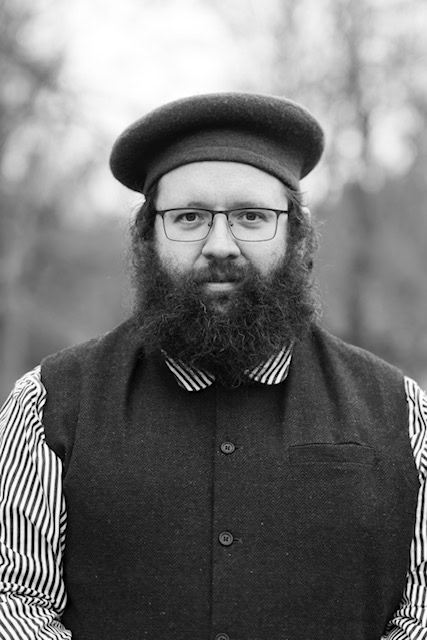
Meet Dell Rose
Dell J. Rose develops and hosts programs for the Swedenborg Library in Chicago and is on the ordination track for the Swedenborgian Church of North America. He holds the position of Swedenborg Doctoral Fellow with the Swedenborg Society in the United Kingdom, and he is a doctoral candidate at the Centre for the History of Hermetic Philosophy and Related Currents at the Universities van Amsterdam.